
Void Vanguard logo 100x100Void Vanguard
X
InsightsPodcastAssessmentPortfolioMethodologyAboutContact
← ALL EPISODES
4
Into the Void
Solo Diagnostic

Episode 04 — Architect: From Policy to Evidence

May 12, 2026

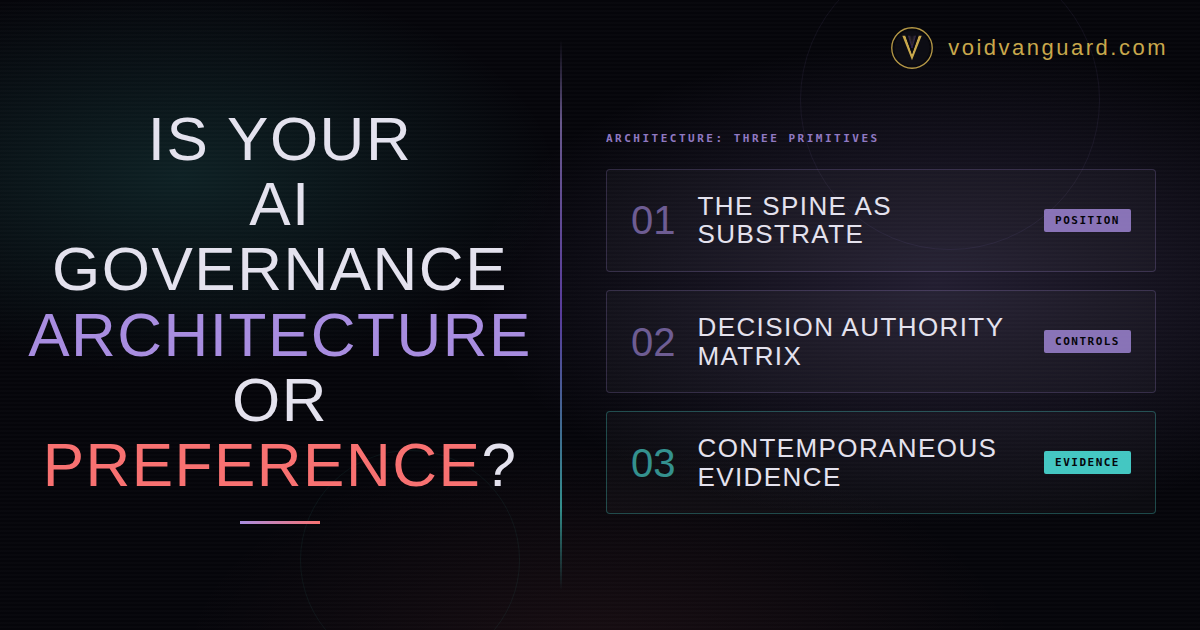
The Architect stage of the Diagnostic Arc. Three architectural primitives that convert AI governance policy into examiner-ready mechanism.
https://www.podbean.com/player-v2/?i=sjhdx-1ac0b21-pb&from=pb6admin&share=1&download=1&rtl=0&fonts=Arial&skin=1&font-color=auto&logo_link=episode_page&btn-skin=7

SHOW NOTES

Episode 04 is the ARCHITECT stage of the Into the Void launch arc. Mark walks the architecture that survived a Deloitte ITGC and ICFR readiness assessment without material findings. Three architectural primitives that convert policy intention into mechanism.

The core concept:

Architecture is the integrity of the sequence, not the prominence of any single stage. If a decision does not land on a Spine stage, it is not architecture. It is preference.

In this episode:

  • The Spine as architectural substrate. Appetite, Strategy, Controls, Evidence, Reporting. Five sequential stages, no skipping. Most institutions operate on one stage and call it governance.
  • The Decision Authority Matrix. The Controls-stage primitive that maps AI risk tier to required approval authority with evidence artifacts. Closes the scope-creep loop that is the single most common failure mode in mid-market AI governance.
  • Contemporaneous Evidence. The Evidence-stage primitive that produces auditable records at the moment a control operates, in a format an examiner can walk in seconds rather than days.
  • Mechanism design vs policy documentation. A policy says scope changes will trigger review. A mechanism says scope change routes to the authority tier the new scope requires, and produces a signed approval record before the change is permitted.

Where Architect sits in the Diagnostic Arc:

Diagnose was the field. Expose was the honest reading. Architect is the design. Proof comes next. The architecture closes the loop opened in Episodes 02 and 03. Cosmetic-to-structural transition, the flinch, the five-question exposure framework. The Governance Spine moves from a diagnostic framework into a design blueprint.

The practical move:

Pick one Spine stage. Instrument one mechanism. Run one evidence cycle. The architecture is built one stage at a time. The Decision Authority Matrix at the Controls stage is the highest-leverage starting point because it produces evidence the moment it operates and forces clarity at the Strategy stage above it.

Built for CISOs, Chief Risk Officers, compliance leaders, and operations executives at mid-market regulated institutions navigating AI deployment with real regulatory exposure.

Next episode: PROVE. Closing the Diagnostic Arc on track record, Maturity Decay, and Program Insurance.

LATEST EPISODES
The Architect stage of the Diagnostic Arc. Three architectural primitives that convert AI governance policy into examiner-ready mechanism.

Episode 04 — Architect: From Policy to Evidence

The Architect stage of the Diagnostic Arc. Three architectural primitives that convert AI governance policy into examiner-ready mechanism.

Episode 03 — Expose: The "Flinch" - Design Failures, Not People Problems

Mechanism failure vs. task failure. The flinch is the reflex that turns structural gaps into persistent ones. Plus the Five-Question Exposure Framework.