Most governance practitioners using AI today are using it as a faster typewriter. They draft a policy and ask the model to clean it up. They paste a control description and ask for a summary. They generate a procedure outline and call it a productivity win.
That use of AI is not wrong. It is just the least valuable thing the technology can do.
The higher-leverage move is to use AI as a sparring partner. A structured challenger. An adversarial reviewer who never gets tired, never gets political, and never lets a load-bearing assumption pass unexamined. Used this way, AI does not write your governance. It pressure-tests it before the examiner does.
What does it mean to use AI as a sparring partner? Using AI as a sparring partner means deploying a language model as a structured challenger to your governance reasoning rather than as a drafting assistant. The practitioner brings the framework, the control logic, or the audit narrative. The model brings examiner-style objections, failure-mode probes, and counter-arguments. The output is not a finished document. It is a stress-tested decision the practitioner can defend.
The Discipline AI Actually Changes
Governance is a discipline of structured disagreement with yourself. Every control has a failure mode. Every framework has a load-bearing assumption that, if it breaks, collapses everything downstream. Every audit narrative has a sentence the examiner is going to press on. The practitioner's job is to find those weak points before they are found for you.
For most of the discipline's history, the only way to surface those weak points was to put your work in front of another practitioner. A peer reviewer. An auditor. A regulator. Each of those reviews carried cost, latency, and political weight. You could not get pressure-tested on a Tuesday morning before sending the deck.
That constraint just lifted. A language model with the right framing can apply examiner-style scrutiny to a control narrative in minutes, surface the questions you did not want to ask, and force you to either defend the design or redesign it. The cost is near zero. The latency is conversational. The political weight is none.
That is the change. Not faster writing. Faster, cheaper, more honest disagreement with your own work.
The Method
Sparring is not a prompt. It is a posture. The practitioner who gets value from this approach treats every interaction with the model as a structured exchange in which the model's job is to find what is broken, not to validate what is built.
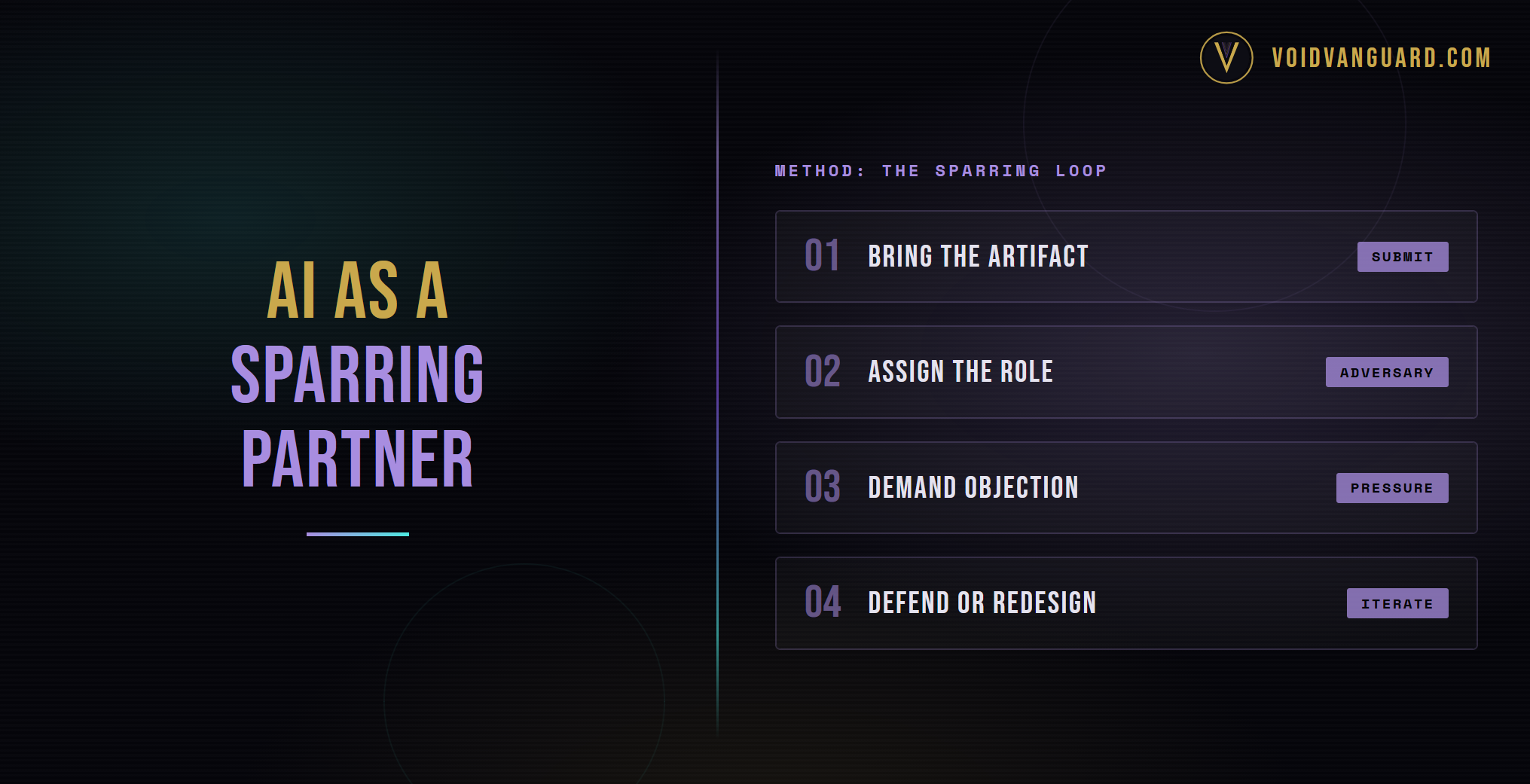
1. Bring the Artifact, Not the Question
The low-value version is asking the model what good AI governance looks like. The high-value version is putting your actual Determination, your actual decision authority matrix, your actual control narrative in front of it and asking what an examiner would press on.
The model cannot stress-test what it cannot see. Generic governance questions produce generic governance answers. Specific artifacts produce specific objections.
2. Assign the Role Explicitly
The role anchors the response. Ask the model to read your control narrative as an OCC examiner who has just received a tip about scope drift in the institution's AI deployments. Ask it to read your AI inventory as a Big Four audit partner staffing a Year One opinion. Ask it to read your board memo as a regulator.
The role compresses thousands of tokens of context into a single sentence and shifts the model from helpful drafting assistant into structured adversary.
3. Demand the Objection, Not the Answer
The instruction matters. "Tell me three questions an examiner would ask about this control" produces a different output than "review this control." The first forces the model into the adversary posture. The second invites it back into the assistant posture, where it will tell you the control looks reasonable and suggest a few editorial improvements.
The practitioner's discipline is to keep the model in the adversary posture across the entire exchange. Every time the model drifts toward validation, redirect it back to objection.
4. Take the Hit, Then Defend or Redesign
The model will surface objections that are wrong, objections that are right, and objections that are uncomfortably close to the truth. The practitioner's job is to triage those in real time.
The wrong objections get dismissed with the reasoning written down. The right objections get acted on. The uncomfortable objections, the ones where the practitioner's first instinct is to argue, are the highest-value output of the exchange. Those are the load-bearing assumptions. Defend them in writing or redesign the artifact.
Where This Has Changed the Work
This method is not theoretical. It is operational. A few recent examples from our own practice:
Pressure-testing a domain framework. The V³ Domain Assessment scores nine domains of AI governance posture. Before publishing, every domain was put in front of a model in the role of a hostile peer reviewer. The instruction was specific: find the domain where the scoring criteria are softer than the others, find the domain where a regulated institution could score Defined (Level 3) without actually being defensible, find the domain that overlaps with another domain enough to create double-counting. Those probes surfaced real weaknesses. The scoring criteria for D-04 Data Governance for AI were tightened because of one of them.
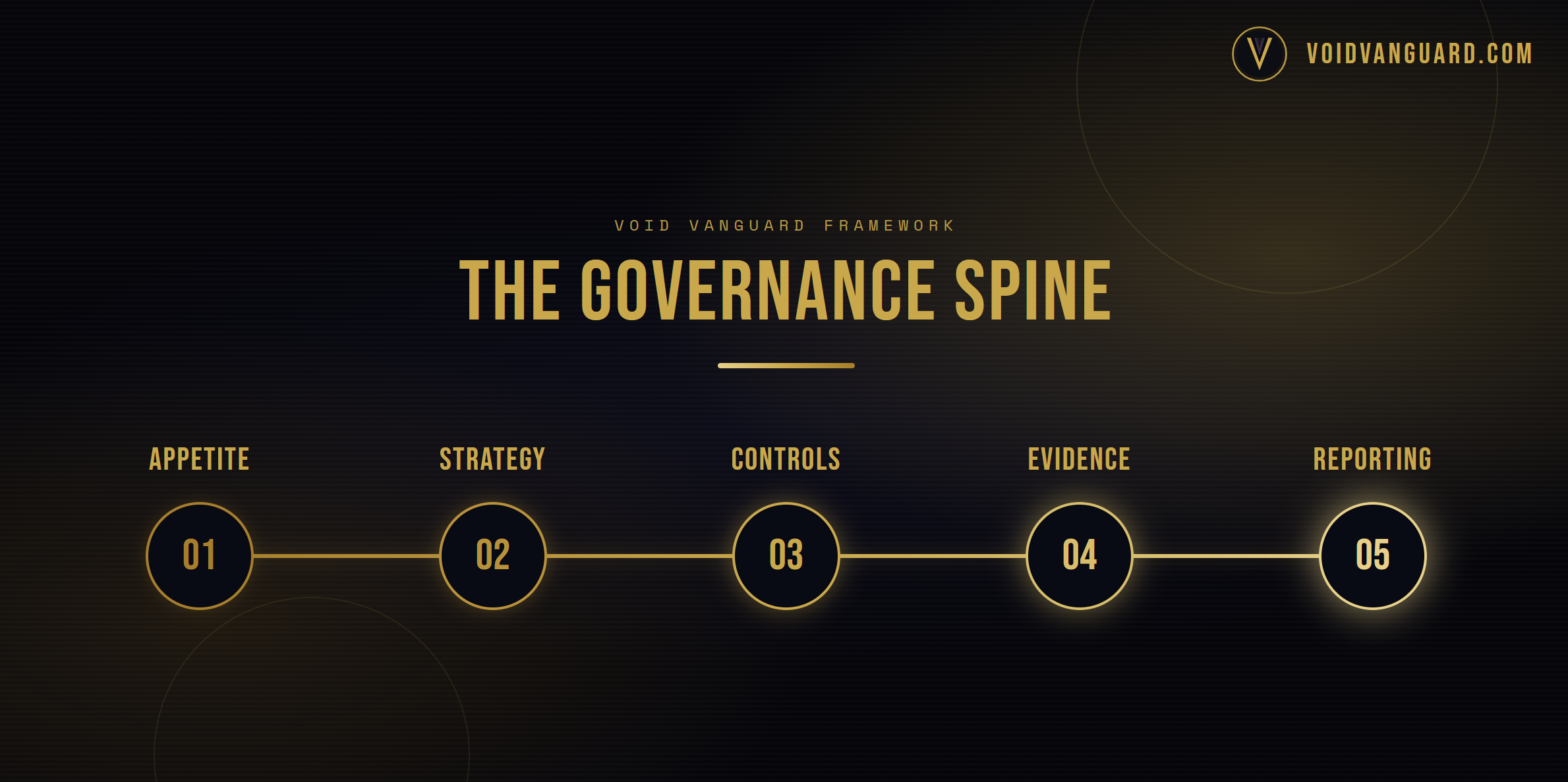
Stress-testing a Governance Spine narrative. The Governance Spine sequence is Appetite, Strategy, Controls, Evidence, Reporting. The narrative reads as obvious once you see it, which is exactly why a hostile reviewer is useful. The model was asked to argue that the sequence was wrong, that Reporting should come before Evidence, that Controls were a subset of Strategy, and that the entire spine was a rebrand of NIST functions. The first two arguments collapsed under pressure. The third produced a clearer explanation of how the Spine operationalizes and expands on NIST functions rather than replacing or imitating them.
What This Method Does Not Do
Sparring with AI does not replace human judgment. It does not produce defensible governance on its own. It does not eliminate the need for actual peer review, internal audit, or examiner relationships.
What it does is collapse the time and cost of the first ten rounds of pressure-testing, so that the human reviewers downstream are pressure-testing a stronger artifact. The artifact arrives at internal audit having already survived twenty examiner-style objections. The reviewer's time is spent on the eleventh-order issues rather than the obvious ones.
That is the multiplier. Not the model replacing the reviewer. The model raising the floor of what arrives at the reviewer's desk.
The Practitioner Identity Shift
Governance is a discipline that rewards practitioners who can disagree with themselves productively. The rare skill is the willingness to take your own best work and ask, with intellectual honesty, where the weakness is.
A sparring partner makes that willingness cheaper. The practitioner who builds the habit of running every load-bearing artifact through structured adversarial review before publishing will produce better governance than the practitioner who waits to be pressure-tested by an examiner.
That is the discipline shift AI introduces. Not the productivity story. The honesty story. The work gets better because the practitioner gets the disagreement they need at the speed the work requires.
The institutions that will deploy AI well are the ones whose governance practitioners use AI on themselves first. Before deploying it in a workflow. Before approving a vendor. Before signing a Determination. The discipline starts with the practitioner's own thinking. Everything downstream traces back to it.
The Diagnostic Question
Pick the most consequential governance artifact you have authored in the last ninety days. The control narrative. The board memo. The Determination. The framework. Put it in front of a model and ask the model to read it as the regulator most likely to pressure-test it.
Then read what comes back honestly. If the objections are unfamiliar, the artifact was not ready. If the objections are familiar but unanswered, the artifact was not finished. If the objections are familiar and the responses are already in the artifact, the practitioner has been doing this work without the tool. Either way, your next artifact will be stronger.
That diagnostic loop is the entire discipline. The tool just makes it cheap.