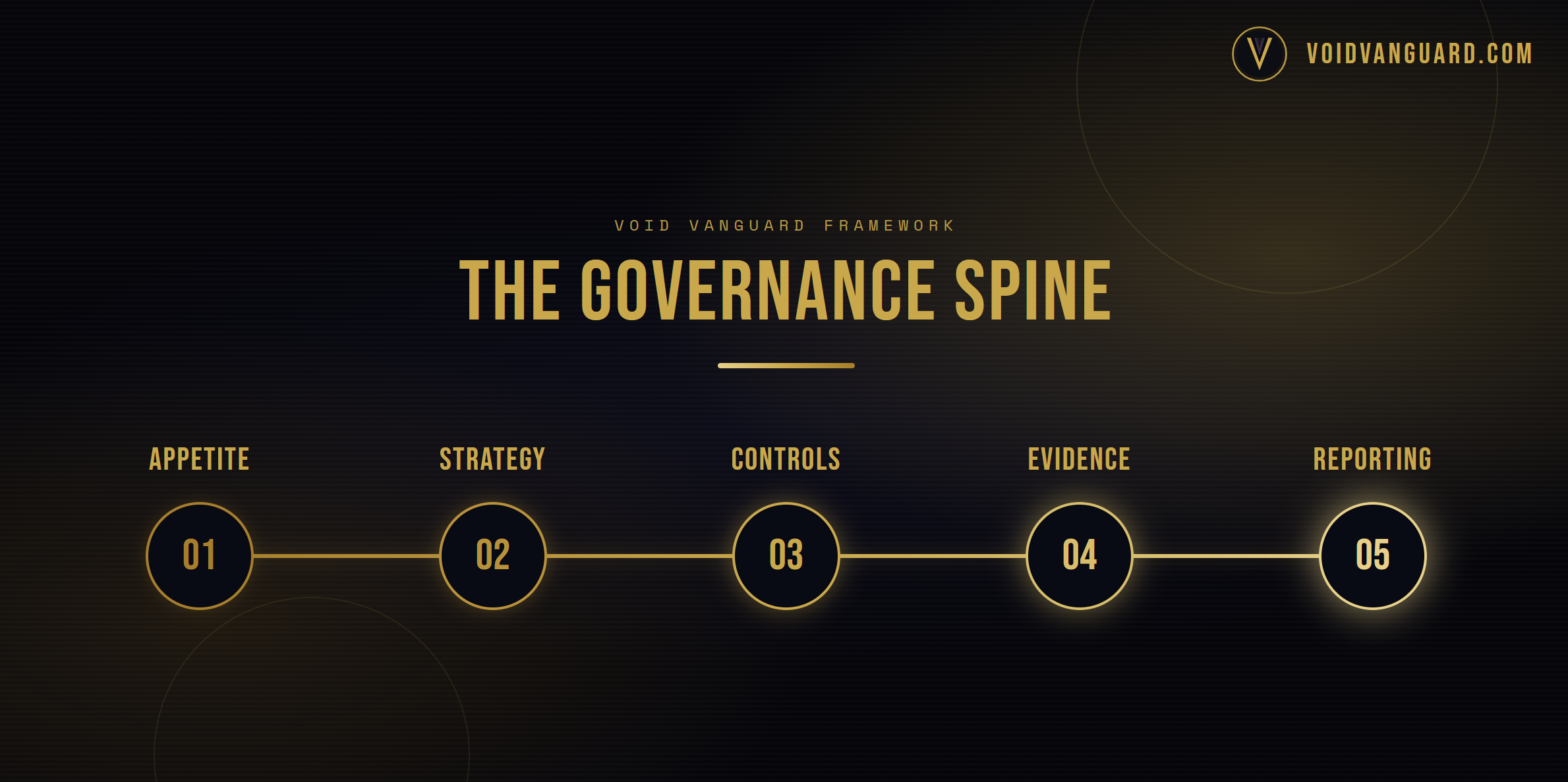
The Governance Spine is Void Vanguard's five-layer model that links an institution's stated risk appetite to the reports its board and examiners read, through Strategy, Controls, and Evidence in between. Its purpose is simple: make every control traceable to an appetite statement, and every appetite statement provable through evidence.
Key takeaways
- The five layers run in a fixed order: Appetite, then Strategy, then Controls, then Evidence, then Reporting.
- Each layer must connect to the one before and after it. A break anywhere makes the whole chain indefensible.
- Most governance failures are not missing controls. They are controls with no traceable link to appetite, or no evidence that they operate.
- The Spine governs AI the same way it governs any control domain, which is why it scales across a program.
What the Governance Spine is
Governance fails examinations not because an institution lacks policies, but because the policies, controls, evidence, and board reports do not connect to each other. The Governance Spine is that connective structure. Read top to bottom, it turns intent into action. Read bottom to top, it turns activity into proof.
The five layers
1. Appetite
A board-level statement of how much risk the institution will accept. For AI, this defines which use cases are permitted, what data models may touch, and how much autonomy a system may have. Everything downstream exists to keep activity inside this boundary.
2. Strategy
How appetite becomes direction: policies, standards, and clear ownership. Strategy translates "how much risk we accept" into "here is who does what, and to what standard."
3. Controls
The specific mechanisms that keep activity inside appetite: approvals, access boundaries, model validation, monitoring. A control with no owner is not a control.
4. Evidence
The artifacts that prove controls operate: logs, approvals, review records, exception reports. This is the layer most often missing in mid-market programs, and the one examiners probe first.
5. Reporting
How evidence is summarized for the board and examiners, closing the loop back to appetite. Effective reporting states not only that controls exist, but that they operate, with the evidence to support the claim.
Where the Spine breaks
- Appetite disconnected from Strategy: the board sets a risk appetite that never becomes policy or ownership.
- Controls disconnected from Evidence: controls are named in policy but produce nothing testable.
- Reporting disconnected from Evidence: board reports assert that controls are effective without underlying proof.
Reading the Spine backward
Examiners often start where the Spine ends. They take a board report, pick a claim that a control is effective, and pull the thread back: show me the evidence, then the control, then the appetite it serves. Wherever the chain breaks is where the finding lands.
Frequently asked questions
What is the Governance Spine?
It is a five-layer model, Appetite, Strategy, Controls, Evidence, and Reporting, that connects an institution's risk appetite to its board reporting so governance is traceable end to end.
Why is the order fixed?
Because each layer derives its meaning from the one above it and its proof from the one below it. Reorder them and the traceability that makes governance defensible disappears.
How does the Spine apply to AI governance?
AI introduces new controls and new evidence, but the structure is unchanged. Appetite defines permitted AI use, Controls keep that use in bounds, and Evidence proves it, all the way up to the board.
Void Vanguard helps regulated institutions deploy AI without regulatory exposure, using governance built to exam standards. The Governance Spine is the structural backbone of the firm's assessment and advisory methodology. Learn more at voidvanguard.com.