COSO's 2026 generative AI guidance reframes AI governance from a policy exercise into an internal control problem, governed by the same 2013 Internal Control Integrated Framework that already governs financial reporting and cybersecurity. For a federally regulated institution, the shift is direct: the question is no longer whether you have an AI policy, but whether you can produce evidence that your AI controls operate.
Key takeaways
- COSO did not publish a new framework. It extended the 2013 Internal Control Integrated Framework to generative AI, routing AI risk through five components and seventeen principles your audit committee already understands.
- Risk lives in the use case, not the product name. Banning a tool is not governance. Inventorying a use case, naming an owner, and producing evidence of operation is.
- The reliance threshold is the concept to internalize: the moment a business process would fail or materially change without the AI, the AI has become a control and must be governed as one.
- COSO, NIST AI RMF, and ISO/IEC 42001 answer different questions. A program citing only one is managing AI in fragments.
- The fastest diagnostic is minimum viable evidence: a documented risk assessment, a named owner, and a monitoring mechanism for each significant use case.
What COSO actually changed
COSO did not introduce a new control framework. It extended the 2013 Internal Control Integrated Framework to generative AI and instructed boards and management to treat AI the way they treat financial reporting, cybersecurity, and regulatory compliance: as a control environment that must be designed, operated, and evidenced.
The guidance replaces the question "do you have an AI policy" with the question "can you produce the logs, inventories, validation results, and monitoring records that show your controls operated in practice." That is the capability lens. Risk does not originate from the brand name of a tool. It originates from how AI is used inside a business process, and how much the institution relies on the output.
The reliance threshold
COSO introduces a concept every institution should internalize before remediation begins: the reliance threshold. A generative AI tool that starts as assistive will, under efficiency pressure, become a tool the institution relies on for decisions. The moment that shift happens, the AI has entered the control environment and must be governed as a control.
The practical test: if a business process would fail or materially change without the AI, the AI is a control. Validation expectations, monitoring cadence, and evidence retention then scale with reliance, exactly as they do for any automated control that touches a regulated decision. Most institutions cannot name the date that shift happened for any of their active use cases. That gap is the finding.
How COSO maps to the Governance Spine
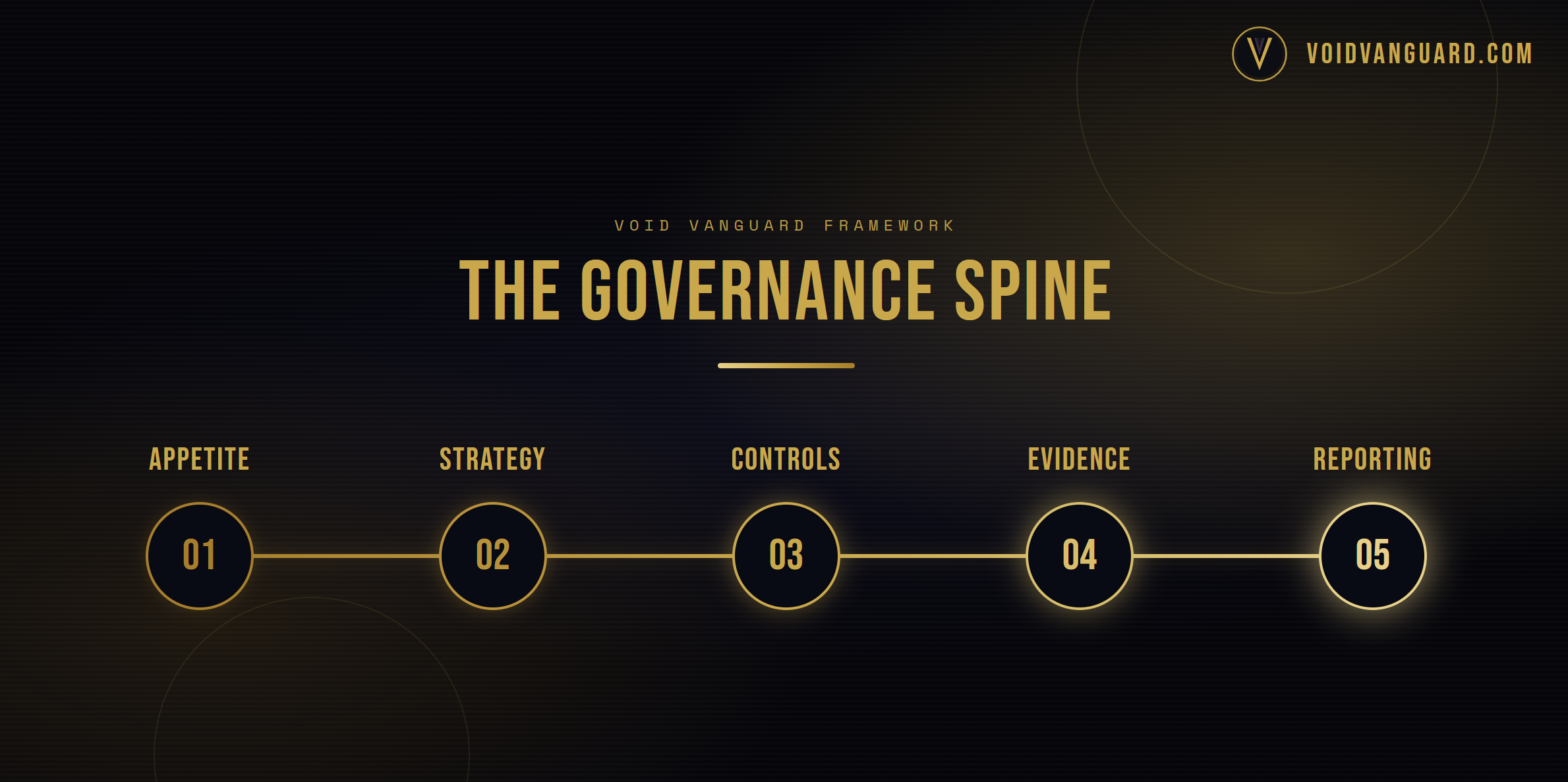
COSO's guidance is the clearest external articulation yet of the five-stage structure we call the Governance Spine. The mapping is direct:
- Appetite. COSO requires the board to decide whether the institution will rely on AI outputs, and under what conditions. That is risk appetite, documented and approved, not assumed.
- Strategy. COSO frames AI as an enterprise risk spanning management, risk, internal audit, and the board. Strategy is the explicit choice of which capabilities to pursue inside that appetite.
- Controls. COSO requires embedded control activities: human-in-the-loop checkpoints, output validation, access restrictions, bias testing, automated logging. Policies are not controls. Mechanisms are.
- Evidence. COSO insists evidence exist as a normal byproduct of operations, not as an after-the-fact scramble. Inventories, validation results, and monitoring logs must be producible on demand.
- Reporting. COSO requires regular governance briefings to the board and audit committee, with AI explicitly scoped into the internal audit plan. No black boxes.
The four failure patterns COSO names
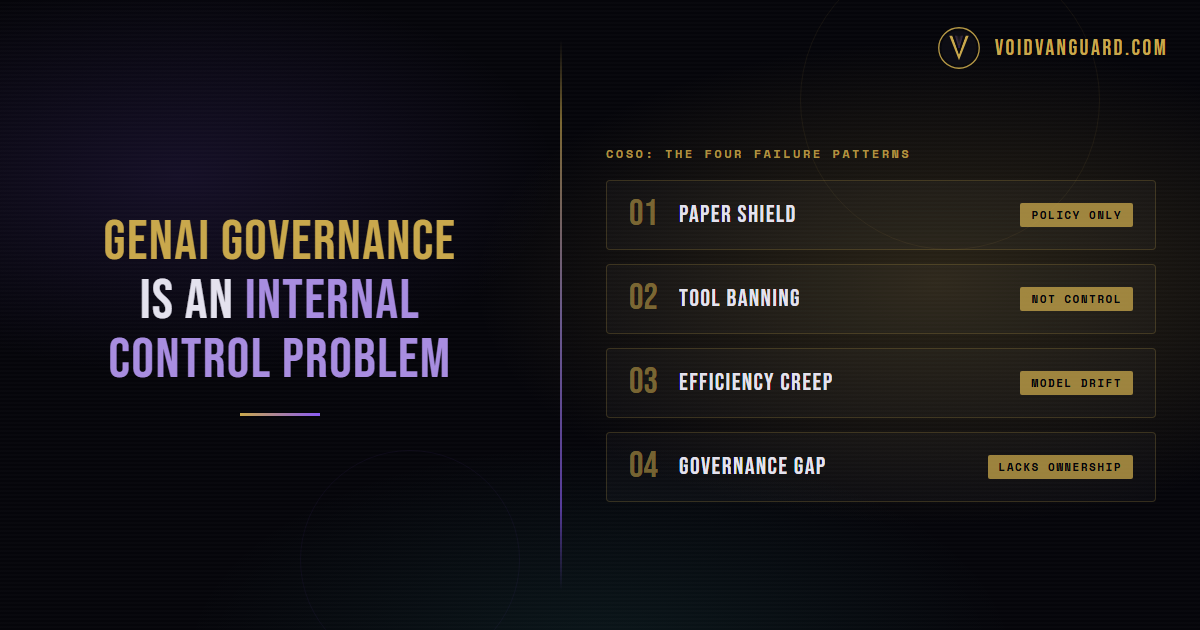
The guidance enumerates the patterns that appear in nearly every early-maturity program. Each maps to a specific stage failure:
- The paper shield. Policy without mechanism. A policy signals intent. A control produces evidence. If you cannot produce a log showing the human-in-the-loop review occurred, the control does not exist.
- Governing tools, not processes. Banning a product and calling it governance. Risk lives in the use case, not the brand name.
- Efficiency creep. Oversight thins as pilots scale. Assistive AI becomes decisional AI without any threshold being crossed on purpose.
- The governance gap. A committee centralizes governance while the real work happens in the business. The result is compliance on paper and unmanaged risk in operations.
How NIST, ISO, and COSO fit together
The three frameworks answer different questions, and a defensible program uses all three:
- NIST AI RMF identifies and categorizes AI risks across the lifecycle.
- ISO/IEC 42001 establishes the management system: roles, policies, processes, documentation.
- COSO establishes the internal control environment and the oversight path to the board.
Map findings to all three and the remediation roadmap holds up in any audit context: regulator, external auditor, or board.
The minimum viable evidence test
COSO's practical starting point is a fast diagnostic. For each significant use case, produce three things:
- A documented risk assessment.
- A named owner.
- A monitoring mechanism.
An institution that cannot produce these three for a use case is operating that use case outside its control environment. If a team cannot name an owner for its top three generative AI use cases in ten minutes, the scope of the work is already defined.
What this means for your program
COSO is external validation of a principle that has governed regulated institutions for decades: governance is measured by the evidence a system produces, not the language a policy contains. The institutions that pass examination are the ones that can route every AI use case through appetite, strategy, controls, evidence, and reporting, and prove each link. The guidance does not add work so much as it names the work that was always required.
Common questions
Is AI governance a policy problem or a controls problem?
Under COSO's guidance it is a controls problem. A policy states intent. A control produces evidence that the intent was enforced. Examiners and auditors test for the evidence, not the policy language.
What is a reliance threshold for generative AI?
It is the point at which a business process would fail or materially change without the AI. Past that point the AI is a control, and validation, monitoring, and evidence retention must scale accordingly.
How does the Governance Spine map to COSO?
Directly. COSO's accountability, enterprise framing, control activities, evidence expectation, and board reporting align one to one with the Spine's Appetite, Strategy, Controls, Evidence, and Reporting stages.
Why is banning an AI tool not a governance strategy?
Risk lives in the use case, not the product. Banning one tool moves the same use case to another tool or into the shadows. Governing the use case, with an owner and evidence, is the control.